
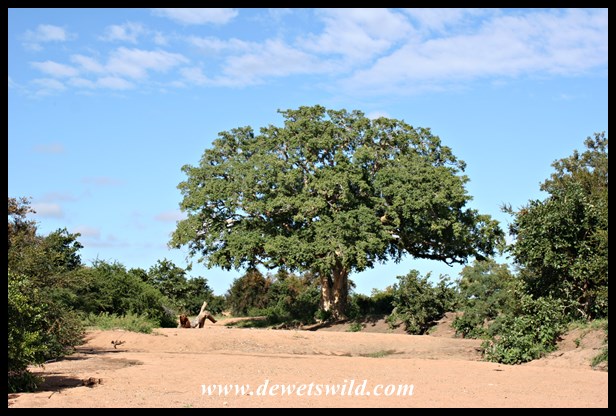
Ficus sycomorus
The Sycomore Fig, or Cluster Fig, is one of our most striking indigenous trees. They grow to an enormous size – up to 25m high with an equally impressive yellowish trunk supporting a widely spread canopy – in the alluvial soils along rivers and streams. Sycomore Figs flower and fruit throughout the year, bearing figs in huge quantities that sustain an incredible variety of insects, birds and mammals, humans included, and this is solely reliant on pollination by wasps of the genus Ceratosolon, which spend most of its life-cycle inside the fruit.
Apart from the obvious use of the figs, and less so the young leaves, as food, humans also use the bark and latex of the Sycomore Fig medicinally. And although the wood is soft, the Sycomore Fig was held in such regard that some Egyptian mummies were even interred in caskets made of the wood!
In South Africa, Sycomore Figs occur naturally in the north of Kwazulu-Natal, Mpumalanga and Limpopo, and beyond our borders throughout central, east and west Africa to Senegal. They’re also found on the Arabian Peninsula and from Egypt to Syria – presumably being the fig tree that is mentioned in several chapters of the Bible. The IUCN lists it as being of least concern.


 DeWetsWild
Fascinating, Dries. The wasps and the medicinal use. There are fig trees all over CA and I must research the different types. Moreton Bay Figs are one. Such beautiful trees.
Agreed, Jane! No wonder fig trees, of all kinds, have been so inspirational through the ages.
Definitely charismatic these venerable trees. Your photos are great and I agree that it would be wonderful to be parked off near a river under an enormous Sycomore Fig just taking everything in …
Thank you very much for the kind and supportive comment, Carol. Hopefully we will have that privilege again soon.
Een van my gunsteling inheemse bome…pragtige foto’s en artikel, Dries!
Wat sal die Sabierivier sonder sy vyebome wees, Dina!?
Dis so waar!
Wow! Wasps inside of figs? No wonder I don’t like figs. >grin<
Beautiful tree, that's for sure.
I admit to also appreciating the tree more than the fruit, John…
Sycamore figs … perhaps I will get to KNP next year! They are beautiful trees and bear interesting clusters of fruit.
Funny the things we miss about the bush without even realising it, Anne. The Sycomore Fig is a good example. Having looked through these pictures I now have such a longing to be able to park the car next to a river in the deep shade of a Sycomore Fig, and just sit and wait and look and listen and smell and dream…
How right you are!
How interesting. I didn’t know about all the things a fig tree was useful for besides delicious figs.
janet
I think most people would be horrified at the pace humans are destroying trees and forests if they knew the full menu of services those trees perform in support of life on the planet.
I agree. Right now the fires in California are destroying trees and many other things, included very old redwoods in Big Basin. I don’t value trees above people’s lives or their homes, but it’s still terrible.
That is horrible, Janet, and we pray with you that the fires are brought under control soon and without further loss of life or property.
I have an Olympia Fig (Ficus Carica) in my backyard. I love figs very much. 🙂
How lucky, H.J! I’m sure you and the birds use it in equal measure?
Such wonderful trees, Dries. Very interesting about the wood being used for the Egyptian caskets. btw, I read that there is at least one wasp inside each fig that we eat. 😯
The symbiotic association between figs and wasps is fascinating, isn’t it Sylvia!?
The Sycomore Fig tree sounds like a very useful one for both humans and animals.
Indeed it is, Hien, and so characterful!
Dis mos die Wonderboom in Pretoria? Lewe die boom darem nog?
Pretoria se Wonderboom floreer steeds, Ineke, maar dis nie dieselfde soort hierdie nie – die trosvy is baie, baie groter.
Ek sien.