
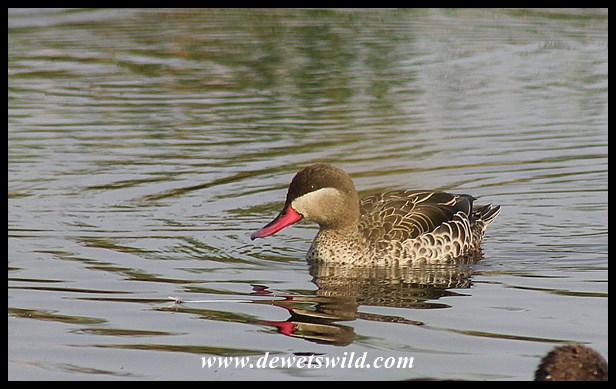
Anas erythrorhyncha
Being a quite common inhabitant of our freshwater dams and pans (and sewerage ponds), the Red-billed Teal can be expected at any inland open water body in South Africa that provides emergent and submerged vegetation. They feed on grass, seeds, waterplants and aquatic invertebrates, mostly at night – by day they rest on the water or at its edge. Apart from South Africa, the species is widely distributed over the rest of southern, eastern and central Africa as well as Madagascar.
Red-billed Teals congregate in enormous flocks at times, especially during their annual month-long flightless moulting period, but are usually seen in pairs when breeding, which may occur throughout the year but mostly follows the rainy season, nesting in thick vegetation on dry land near temporary or permanent expanses of water. Clutches consist of 5-12 eggs, and are incubated for a month by the female only, the male by this stage having long abandoned the family. The chicks take to the wing for the first time about two months after hatching.
Adults grow to a length of about 46cm and both sexes weigh just over half a kilogram on average. The Red-billed Teal is listed as being of least concern by the IUCN.


 DeWetsWild
Die voetjies onder die water… ‘n mallemeule?
Oulike gaansies! 😉
Dink ons ook!
I particularly like the shot of the pair in the shallows. The one shows such a surprisingly dappled/speckled breast!
Thank you, Carol!
An excellent array of photographs.
Thank you again, Anne!
A very attractive duck, Dries. 😍
Much more good-looking than Daffy, hey Sylvia?
That’s for sure. 😃
Oh, it is lovely, Dries. ❤
Agreed, thanks Tracy!
You’re welcome, Dries.
Such a beautiful bird!
I assume this is the male? If it was a female I would praise her pretty natural lipstick 🙂
Hope you and your family are doing well.
Thank you Takami. Yes, we are well and enjoying a magical bush holiday again. Hope you are doing fine too?
In fact, the sexes of the Red-billed Teal is quite similar in appearance.
Oh that’s lovely to hear! We are doing well too, and it’s also great to learn more about this Red-billed Teal 🙂
Pretty bird! 🙂
Definitely, thanks H.J.