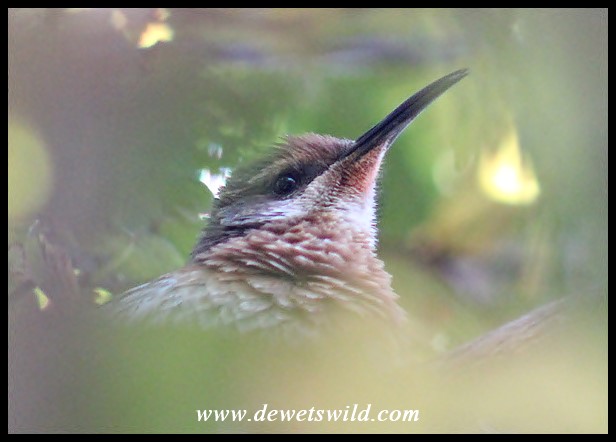
Promerops gurneyi
Gurney’s Sugarbird has a patchy distribution on the highlands on the border between Zimbabwe and Mozambique, in Swaziland, Lesotho and South Africa (suitable parts of Limpopo, Mpumalanga, Kwazulu-Natal and the Eastern Cape), where it inhabits montane grassland and scrub dominated by proteas and aloes. They feed on nectar from a wide range of flowering plants and also include insects and spiders in their diet to a lesser extent.
Usually seen singly or in pairs, Gurney’s Sugarbirds only congregate in larger numbers at rich food sources. When breeding they form monogamous bonds, with the male defending the pair’s territory while the female builds the nest; a shallow, cup-shaped formation of twigs, grass, rootlets and bark lined with grass and fluffy protea-seeds usually placed in a fork in a protea bush. The breeding season spans the spring and summer months. The female alone incubates the clutch of 2 eggs over a period of about 3 weeks, while both parents feed the chicks, which leave the nest when they’re 3 weeks old, on a diet of insects and spiders. The chicks remain dependent on their parents for another 3 weeks or so after fledging. Fully grown Gurney’s Sugarbirds measure up to 29cm long (including the tail) and weigh between 30 and 40g.
Gurney’s Sugarbird is classified as Near Threatened by the IUCN, owing to an apparent decline in their numbers likely attributable to loss of their preferred habitat to commercial plantations and damaging land management practices.


 DeWetsWild
What a treat to see these birds and lovely photos too. Lovely to see.
Thank you, Carol!
Lovely
Your photos of the bird are amazing! We never saw it when we visited. Is it seasonal! You have such incredible birdlife there Dries!
Thanks very much, Tina. The Sugarbirds are year-round residents – you’ll have to return to come look for them!
Beautiful little creatures!
They’re sweet all-round. Thanks for popping by, Montucky!
Wonderful images Dries and what a beautiful little bird 🙂🐦
Thank you very much, Xenia! We’re glad we could introduce you to our sugarbird!
Dis nou baie besonders,Dries!So jammer dis weereens ‘n bedreigde spesie.Pragtige foto’s!
Baie dankie, Dina. Beslis n groot jammerte dat sulke unieke voels weereens deur ons toedoen aan die afneem is.
They are lovely birds to see. I have only once seen one in our town – it was visiting a stand of proteas on the edge of the suburb. This has been removed over the years, doubtless by avid gardeners wanting to transplant them.
Yep, with the Proteas gone there’d be no reason for them to remain. Sad loss really.
Sulke pragtige voels, tog so anders as die wat hier by ons voorkom
Ek vind dit interessant dat die Kaapse en Rooiborssuikervoel se gebiede se grense so na aan mekaar is, maar dat hulle glad nie op enige plekke saam voor kom nie.
Dit is ongelooflik.
beautiful birds
Thank you, Gavin
Beautiful photo of a lovely bird!
Thanks very much, Granny!
You have some especially lovely shots in this group, including the header photo and in the middle. Just wonderful.
janet
Thanks a lot, Janet!
Hello Dries,
I agree, what a beautiful bird, and what beautiful nature! I appreciate that you share these experiences with your international friends 🙂 The name “sugarbird” is a sweet name for this bird 😀 All best wishes to you and your family.
Thank you very much, Takami! I agree, they really do deserve their name not only for their love of nectar but also for their sweet song and soft appearance.
Have a lovely weekend!
Wonderful picture Dries! I must admit that I´m very jealous of you! So much nature and animals year around!😊 I’m longing to come to south Afrika and Kruger park!😊
Thanks very much, John! We also hope that you’ll soon be able to visit South Africa and the Kruger Park. And the Drakensberg. And the Kalahari. And the Cape of Good Gope. And the Garden Route. And the Bushveld. And Zululand. And Namaqualand. You’re going to need long leave to see all our most beautiful places!:-D