Monthly Archives: May 2019

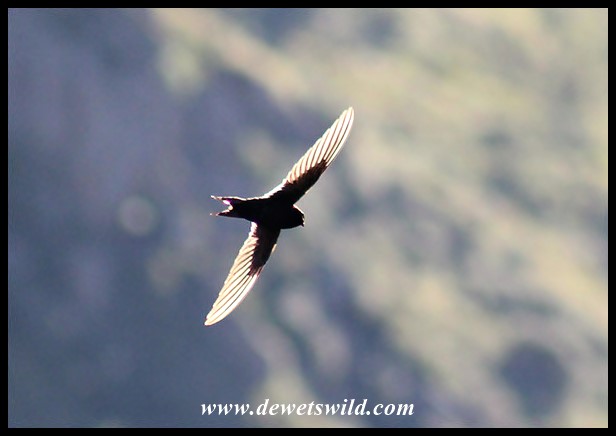
White-rumped Swift

White-rumped Swifts visit South Africa from equatorial Africa during our warmer months (August to May, though a few stay through the winter). They’re usually seen on the wing, catching flying insects over open country, often close to water and commonly in towns and cities. Usually seen in small flocks of around a dozen, they migrate in larger groups of up to a hundred.

Monogamous pairs of White-rumped Swifts often breed in colonies throughout spring and summer, usually in nests hijacked from other kinds of swifts and swallows. Clutches consist of 1-3 eggs and are incubated for about 3 weeks. Compared to many similarly-sized birds the chicks develop slowly and only fledge shortly before reaching two months old. Adult White-rumped Swifts measure 16cm long and weigh around 24g.

The IUCN lists the White-rumped Swift as being of least concern.

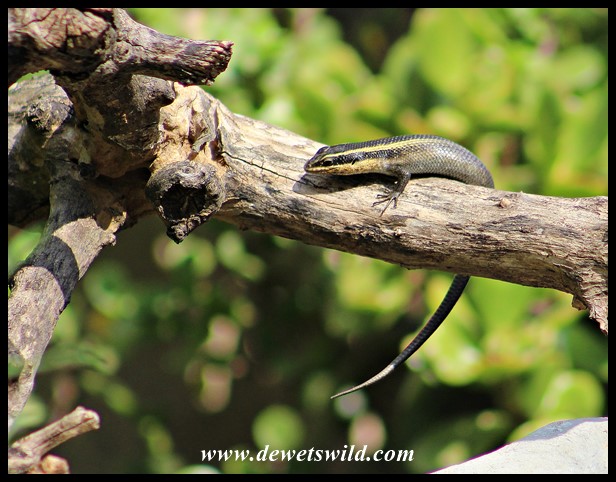
Speckled Rock Skink

Trachylepis punctatissima

The main population centre of the Speckled Rock Skink, a common and very adaptable lizard, encompasses Botswana, Lesotho and South Africa (Free State, Gauteng, western Kwazulu-Natal, Mpumalanga, Limpopo, North West and the eastern reaches of the Northern Cape) with a seperate population along the borders of Zambia and Malawi. They are diurnal, enjoy basking in the sun, feed on small invertebrates and inhabit a wide range of rocky grassland and savanna habitats, as well as urban landscapes. Speckled Rock Skinks become very tame around houses, especially where marauding pet cats are not a threat. In the colder, high-lying parts of their range they may hibernate through the harshest winter months. Females give birth to litters of 3-9 babies in summer. Adults measure around 19cm in length (including the tail).

The Speckled Rock Skink is closely related to the Striped Skink, was originally considered a race of that species, and is listed as being of least concern by the IUCN. It is also known as the Montane Speckled Skink.

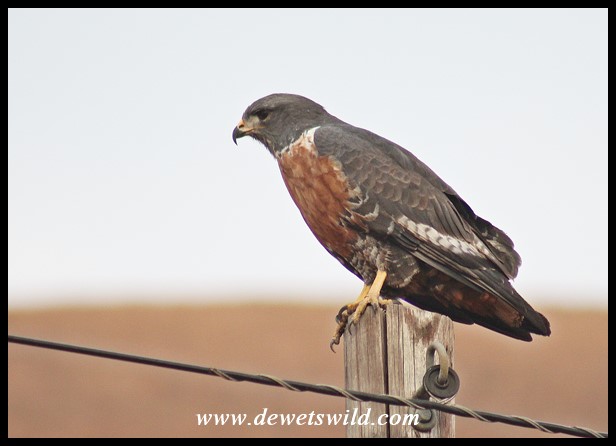
Jackal Buzzard

Buteo rufofuscus

The Jackal Buzzard is a large bird of prey (wingspan up to 1.4m, weight up to 1.7kg, females being the larger sex) found only in Namibia, Swaziland, Lesotho and South Africa. While they do occur over arid scrublands, open grasslands and agricultural areas they are most common in hilly and mountainous areas where they are usually the most numerous and conspicuous large raptor. They feed mainly on small mammals, birds, reptiles and carrion and occasionally insects and frogs.

Outside of the spring & summer breeding season they’re usually seen singly, though pairs do seem to be monogamous and share a territory. Nests are built atop large trees or rocky ledges and are often re-used in consecutive years. The female incubates the clutch of 1-3, eggs, while the male brings food to her over a 6 week period, with the chicks staying in the nest for up to 2 months after hatching before attempting their first flight. Last hatched chicks are often much smaller than their sibling and frequently dies as it cannot compete for food. The chicks stay with their parents for quite some time after leaving the nest.

The Jackal Buzzard gets its name from its call, which could easily be confused for that of the Black-backed Jackal. It is considered of least concern by the IUCN, though unintentional poisoning may be a concern. They have a life expectancy of around 25 years.

Common Blue Butterflies

Leptotes species

We have four-species of Leptotes butterflies that are so similar to each other that they’re impossible to distinguish in the field. Three of these, the Common Zebra Blue (L. pirithous), the Babault’s Blue (L. babaulti) and Short-toothed Blue (L. brevidentatus) are widely distributed over the country, while Jeannel’s Blue (L. jeanneli) occurs only in the Lowveld.

The Common Blues inhabit a wide range of natural vegetation, cultivated fields and gardens all over the country throughout the year. They’re also familiar over most of the rest of Africa, Madagascar, the Near East and southern Europe. Adults often congregate at wet mud and have a wingspan of 2-3cm.

The larvae feeds on Plumbago and plants from the legume family. Adults are on the wing year-round, though much more numerous in the warmer months. Their complete life-cycle spans about 2 months.
Cape Turtle Dove

Streptopelia capicola

The Cape Turtle Dove, also known as the Ring-necked Dove, is one of South Africa’s most common and widespread birds, occurring in every corner of the country in a wide range if habitats, both natural and man-made. They feed on seeds, fruit and small invertebrates, foraged predominantly on the ground.

Cape Turtle Doves breed throughout the year and the monogamous pairs may raise up to 5 broods annually. They construct flimsy stick platforms for use as nests in which 2-4 eggs are incubated for about two weeks. The chicks are looked after by both parents and leave the nest when they’re about two weeks old, after which they may stay with the parents for as long as three weeks before becoming fully independent. Though they’re mostly seen singly or in pairs the Cape Turtle Dove may congregate in large flocks numbering in the hundreds, especially at waterholes or feeding grounds.

Adult Cape Turtle Doves measure about 27cm in length and weigh around 150g. Their peaceful song is a welcome addition to the playlist in any garden. Apart from South Africa, Cape Turtle Doves are also to be found over all of Africa south of the equator and extending to Ethiopia and Somalia in the north-east. The IUCN lists the species as being of least concern, and it is probably expanding both its distribution and population.

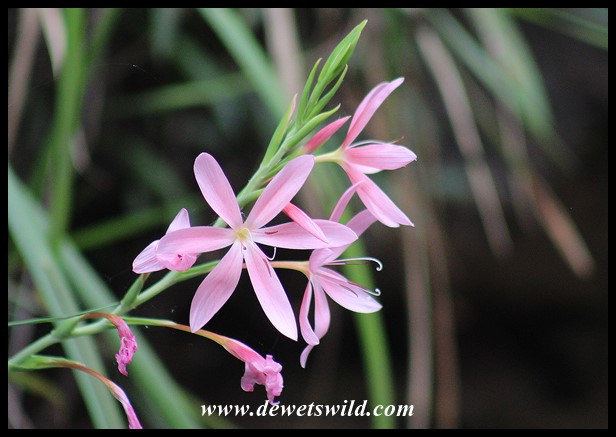
River Lily

Hesperantha sp.

The River Lily is a much-loved plant in gardens the world over, but it grows wild here in saturated soil along the mountain streams of South Africa’s Drakensberg Range. These bulbous plants stand about 50cm high, grow and flower in full sun during summer with the beautiful blooms being carried from December to April. Apart from the pink form shown here there’s also white and bright red varieties growing wild, while cultivated forms with much wider petals than the wild forms are normally sold at nurseries. The flowers are pollinated by butterflies and flies, and the whole plant goes dormant in winter.