
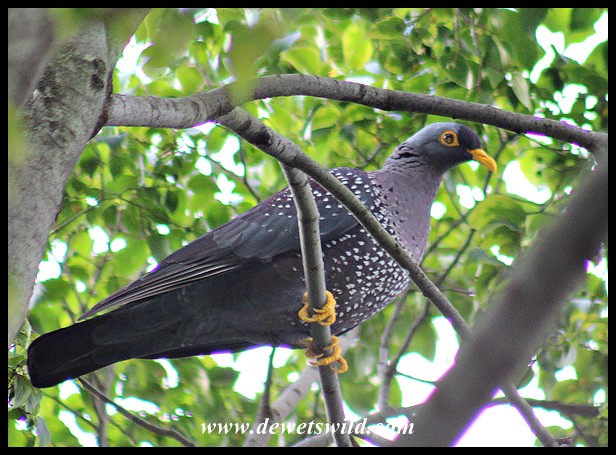
Columba arquatrix
The African Olive-Pigeon, previously known as the Rameron Pigeon, is a large, dark dove inhabiting forests, woodlands and plantations, moving around locally to wherever fruit trees are bearing. Apart from fruits and berries they’ll also consume insects encountered while foraging. Adults measure about 40cm in length and weigh around 400g.
African Olive-Pigeons are mostly found in flocks numbering between 5 and 70, though larger aggregations in the 1000’s may come together in prime feeding areas. Pairs are monogamous and probably territorial to some extent while nesting. They breed throughout the year. Clutches of one or two eggs are incubated for a period of about 3 weeks in large stick nests built high up in dense trees, with the chicks fledging about the same length of time after hatching.
The IUCN lists the African Olive-pigeon as being of least concern. Its range extends from Eritrea southwards to South Africa, though its specific habitat requirements means that it is rather patchily distributed throughout. Here in our country they’re found mainly along the southern and eastern coasts and adjacent interior, and in the temperate forests found along the escarpment. It is only in recent years that they seem to have moved into the urban “forests”of Gauteng province’s big cities boasting with well-planted gardens and parks suitable to their needs.


 DeWetsWild
Wonderful, a first as have never heard of this one.
Very glad we could introduce you to our African Olive-Pigeon, and welcome here!
Beautiful creature!
Nodding in agreement!
A favourite of mine too. They are fast fliers so those photos of birds in flight are impressive!
Thanks, Carol! They were flying between a fruiting white stinkwood standing at Tendele’s reception and the forest behind the chalets, giving me the opportunity to get almost eye-level shots of their fly-by’s – of which two thankfully turned out good enough to post here.
They’re really attractive. I love the markings on the breast feathers and the contrasting yellow bill and feet.
It amazes me that such bold markings can be such excellent camouflage!
Nature is amazing. 🙂
Absolutely!
Allerpragtigs – dis einste die duif wat so ‘n rukkie terug hier uit Pretoria-Oos se verkeer gered is!
Het jy ook opgelet dat hulle deesdae heel volop hier in PTA en omstreke gesien word, Tannie Frannie?
Nee, Dries – daardie duif in die straat was die eerste een wat ek hier rond gesien het. Het dit glad nie geken nie, maar Perdebytjie het dit n.a.v. my beskrywing uitgeken.
Dis lekker om die natuur so naby aan ons te he!
Baie statige imposante duif. Jou eerste/hooffotos is besonders.
Baie dankie, Ineke – ek was baie bly om n paar ordentlike fotos van hul te kon kry wat ek hier kon deel.
Ek het die rooioog kransduiwe hier by my op die plaas.
Hulle is net so pragtig, en het die mooiste deuntjie wat hulle koer!
I have only recorded a Rameron Pigeon once in my garden, although they can be seen in the nearby Thomas Baines Nature Reserve.
I would’ve bet good money that they’re a frequent visitor in your garden, Anne, given how many other “forest” species you harbour there!
I might simply not see them in the fig tree 🙂
They’re quite adept at hiding, so that may well be true!
that’s on very beautiful bird
I agree wholeheartedly!
I love the markings!
janet
To my mind one of our most beautiful pigeons.
nice article…
Thank you!