Acontias plumbeus
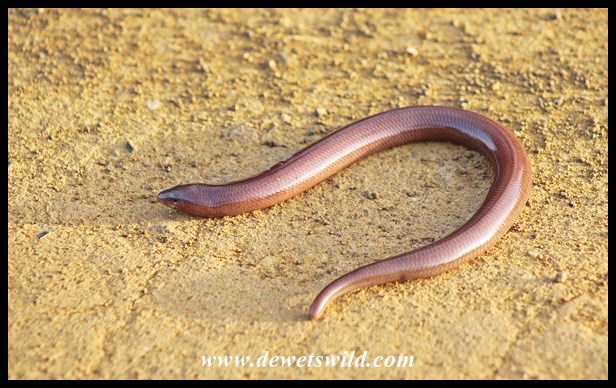
The Giant Legless Skink is a southern African endemic, occurring only on the highlands of Zimbabwe and neighbouring Mozambique, the extreme south of the latter country, Swaziland and South Africa’s Lowveld, Kwazulu-Natal and an apparently isolated population around East London in the Eastern Cape. It is not a snake but actually the world’s largest skink (type of lizard), measuring up to half a meter in length. The Giant Legless Skink lives in damp soil and leaf litter, mainly in a variety of forest and thicket habitats, and sometimes emerges above ground following drenching rains. It feeds on invertebrates, frogs and smaller reptiles. In late summer females give birth to between 2 and 14 live young.
The IUCN lists the Giant Legless Skink as being of least concern.


 DeWetsWild
Fascinating animals. Interesting to read what distinguishing these from snakes (e.g., eyelids!). Thanks for the post.
We also think this legless lizard is worthy of a little attention! 😀
At first glance I thought it was a large earth worm. Very interesting!
Glad to know, thank you!
That first photo is just lovely.
Thank you very much, P J B!
Jy sê jul sien hul veral na reën. Is dit dat hul wil verdrink of uitspoel? lyk maar bietjie grillerig.
Die grond raak versadig met water en dan vind hul dit moeilik om ondergronds te beweeg en asem te haal, Ineke, en kom dan na die oppervlak. Met eerste oogopslag lyk hul seker grillerig, maar ek dink die idee van n pootlose akkedis is fassinerend – moes wees hoe die eerste slange gelyk het.
Is beslis n vreemde gedoente. Nie erdwurm ook nie akkedis of slang nie. Interessante affêre
Hy het kinkels soos ‘n wurm of ‘n slag , dus nie ‘n gunsteling nie
Ek sien die mense is nogal verdeel oor hierdie kereltjie – of jy is mal oor hulle of hulle laat jou gril!
Very interesting little guy! I wonder why this genera decided to ditch the running sticks? 🤔 I wonder if the biologists will reclassify them someday.
The legs must’ve been lost during the evolution to a subterranean life, and I think the scientific world probably have already corrected its classification – when first discovered it must’ve been thought of as a snake – I mean just look at it!
{shudder} … a legless skink, by any other name, still looks like a snake to me.
I see the comments are quite undecided about this chap, Joanne – seems you either “love it!” or “hate it!” I think its fascinating to see a lizard this size without any legs!
Interessant. Nog nooit so iets hier raakgeloop nie. Ek kry gereeld paddas wat vlak onder die grond oppervlakte lê wanneer ek die tuin omspit. Ook nie geweet daar bestaan so iets nie.
Daar is n baie besonderse wereld onder die grond wat ons omtrent nooit te siene kry nie en nog minder van weet, Petru. Ek kan net dink hoeveel soorte onbekende diere afgemaai word wanneer groot stede en dorpe so teen n pas uitbrei.
So twee jaar gelede was hier ‘n firebreak wat weggehardloop het – een vlagie wind en die hele kant van die kloof is daarmee heen. Ek weet nie hoeveel dekades dit net gelos is dat dit groei nie. Ek was veral jammer vir die diertjies. Duisende akkedisse en wie weet wat nog is daarmee heen. Selfs die ondergrondse wortel sisteem van party bome het so weggesmeul. As mens daarop loop nou is dit amper soos spons.
Vuur kan verskriklike skade aanrig, veral met menslike oe beskou, maar ek staan dikwels verbaas hoe vinnig die natuur eintlik weer terugkom in n gebied wat vir n mens heeltemal vernietig gelyk het!
Dit het ‘n ruk gevat maar dit is besig om te herstel!
What a beauty.
We think so too, thanks Tracy!
Jy was omtrent gelukkig om dit te sien! Mens kan maklik dink dis ‘n slang. Uitstekende foto’s, Dries.
Baie dankie, Dina. Ons was gelukkig om hulle nou al so 3 of 4 keer te gesien het, altyd vroeg oggend na swaar reen.
How wonderful that you managed to photograph these.
Very fortunate to have seen them on a few occasions, Anne – many people don’t even know of their existence.
Amazing creature!
We agree wholeheartedly!
These are much larger than the ones in the U.S.A. The ones here you could hold in the palm of your hand.
As always, thank you for the information.
Do you often encounter the US species, Tim?
When I was in my teens I be hunting for lizards and snakes. Occasionally I’d find them this mostly in the San Francisco Bay Area. I’m not sure after 50 years how many remain.
Most interesting, thanks Tim. Sadly yes, construction projects requiring deep excavations will be wholly incompatible with these types of lizards’ chosen lifestyles.
We still have a lot of pasture and grazing lands that have lots of fall oak trees that are ideal areas for lizards, snakes and other reptiles. All is not concrete thank goodness.
Most certainly, thank Goodness!
This is amazing! I wasn’t aware of this unique creature 🙂
Few people are, Takami, for they so seldomly emerge above ground.
It’s always exciting to learn something new, and I think this fellow is cute 🙂 Thank you for your reply!
Thank you for allowing us to introduce you to our Giant Legless Skink, Takami!
Yes it looks a lot like an earthworm!
Pity the photos doesn’t really convey its size better, Robert
It is actually resembled a large earthworm We have e legless lizard in Sweden, copper lizard (Slow worm) Many think it is a snake
Indeed John, they do look very snake- or wormlike!
Not a very attractive lizard at all. I prefer my Florida friends. 😃
Agreed that its not going to win a modelling contract at any stage, but I bet the Giant Legless Skink will be picked as the Lizard Rugby Team’s captain!
Haha……you’re so funny, Dries. 🤣 That’s a match I’d like to watch.
Interesting but not really my favorite by a long shot. 🙂
janet
They look a little too serpentine for you, Janet?
Just not that interesting, I guess. 🙂 But that’s OK.
Thanks for the honesty, Janet!
I do love the name, though!
Fascinating and your photos have captured it so well. Not the easiest creature to photograph effectively.
Thanks very much, Carol! Indeed, they’re not often seen and when we do its always been from a vehicle in a location where you’re not allowed to alight, making it difficult to get a good side-on shot. Nevertheless seeing one is always a treat!
Even more remarkable that the photos were taken from a vehicle!
Thank you, Carol.