
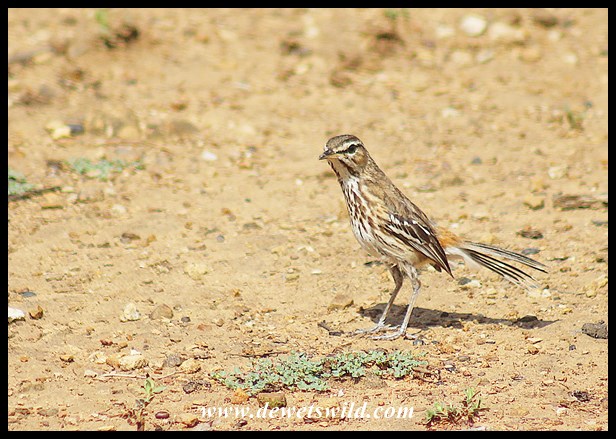
Cercotrichas leucophrys
An inhabitant of thorny savannas and woodlands with good grass covering, the White-browed Scrub Robin is a shy bird with a fairly characteristic song most often heard at sunrise or sundown. They feed predominantly on insects, especially ants and termites, caught on the ground. White-browed Scrub Robins are usually encountered in monogamous territorial pairs and breed in spring and summer. Their nest is a deep cup-shape built in dense foliage or thick grass, usually quite low to the ground. Clutches usually consist of 2-4 eggs and are incubated by the female only for a 2 week period, though both parents take an active role in feeding the chicks.
Adults weigh around 20g and grow to 15cm in length.
The White-browed Scrub Robin has a wide distribution through east, central and southern Africa. In South Africa they occur from the North West Province to the Eastern Cape, through Gauteng, Limpopo, Mpumalanga and Kwazulu-Natal. The IUCN lists the White-browed Scrub Robin as being of least concern.


 DeWetsWild
Such a pert and lovely bird.
Did you get a few pics of them at Mpila when you visited recently, Carol? Almost all the photos in this gallery were taken there on various visits – the only sure place I know you can go to see them.
Well no – I didn’t notice any at the tented camp, although in retrospect we might have heard them without registering. Will look out for them when next we visit. The only place I have ever photographed them was at a permaculture garden in the Eastern Cape where they had nested.
Guess who’s back to bug you in the comments section? 🤔 It’s Midwestern Plant Girl! I’ve returned to blogging and opening a nature biz 😍 I’m so glad to see you’re still blogging! I’ll have to catch up 😁😁
So nice to have you visiting us again, Ilex! Welcome back!
I love the intense expression on this bird! As always, thanks much for sharing. All best wishes to you and family 🙂
Thank you for visiting us again, Takami, and best wishes to you and your loved ones as well!
What an alert looking little critter! 🙂
janet
Ain’t no creepy-crawly insect snack that can escape those eyes, that’s for sure!
Nice, they look a little like the sparrows which is used to abound here, but now they have become very less in number.
That must be really disconcerting – sparrows usually do very well around humans!
Till about twenty years ago they were in abundance. They used to try to build their nests inside the house. We don’t know why, but we are seeing less and lees of them. It is very sad.
Did you notice an increase perhaps in the numbers of a different kind of bird that may be pushing the sparrows out?
Actually , small sunbirds are in plenty. Interestingly we see sparrows near grocery shops ! I will ask a friend who is very interested in birds.
Would be very interesting!
Beautiful little bird! I appreciate that you have such a nice mix of all the birds on your blog! 😀
Nice mix of animals shall it stand! Sorry, not healthy tired 24 Hours/day…
Sounds like you have severe case of burnout, John, and I really am wishing you a speedy recovery to good health!
Thanks Dries! tired 24 hours a day so I just want to sleep but force myself to sit up.
I truly hope you recover soon, John – I can imagine how debilitating this condition must be!
Thanks Dries! I’ve been to the emergency 3 times, but they do nothing. They have booked a medical examination for me in … two weeks !!! “Sweden has the world’s best healthcare” Did they say when you went to school …
That sounds exactly like state healthcare here in South Africa, John, and I guess you must feel very disheartened by the poor assistance.
Thanks, John! I really love putting these posts together, it helps me a lot to get rid of the daily city stress.
What a sweet little fellow. Thanks for providing the sound track as well.
Peta
Glad you enjoyed it, Peta, and welcome here!
She looks like such a tiny little mite (I’m assuming she was a she) – easily overlooked while blending into her environment.
The sexes of this species are very much alike, Joanne, and as these photos were collected over a few years hopefully there’s examples of both male and female included, though I wouldn’t know which is which!
And you’re 100% correct about that excellent camouflage!
I have enjoyed looking at your photographs.
Thanks very much, Anne!
Dis so ‘n skatlike voëltjie, met sy strepieslyfie! Pragtige foto’s, Dries.
Baie dankie, Dina!