
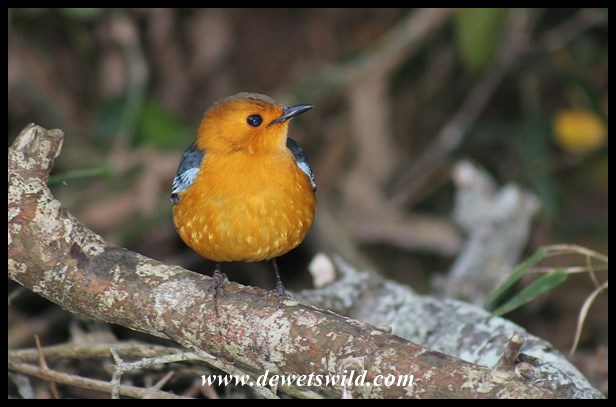
Cossypha natalensis
The Red-capped Robin-Chat is an inhabitant of forests and dense woodlands, in South Africa to be found from the Eastern Cape through Kwazulu-Natal into the Lowveld and escarpment of Mpumalanga and Limpopo, and north of our borders widely through central and east Africa into southern Ethiopia. Insects make up the bulk of their diet and they are usually seen singly or in pairs.
Red-capped Robin-Chats breed in spring and summer. Pairs are monogamous and build cup-shaped nests in dense foliage or inside holes in trees, laying clutches of 2-4 eggs. This species occasionally hybridizes with the Chorister Robin-Chat. They are talented songbirds that can mimic up to 40 other kinds of birds, the whistling of a human and even the barking of a dog! Adults weigh around 32g with a length of about 16cm.
The IUCN classifies the Red-capped Robin-Chat as being of least concern.


 DeWetsWild
Another favourite! A friend of ours had a resident robin that learnt to imitate her alarm clock and included it in its repertoire 🙂
That must have been quite something to hear, the alarm going of at any time of day! 😀
Great shots of a lovely bird!
Thank you, Kathy!
Beautiful little birds! I bet they are welcome wherever they are found.
They’re great helpers to those gardeners lucky enough to host them!
Oulik!
Dit is hulle beslis, Tina
🙂
A bird with ‘cat’ (a la Francais) in its name barking. Imagine that. 😉
They’re such good impersonators that hearing such unexpected sounds while walking in the forest can be quite a surprise!
These are such cute little birds, nice gallery of photos 🙂
Thank you very much, P J B – we’re lucky to have seen a few obliging individuals over the years as they are usually quite shy.
So cute 😍
So they are!
This is one very cute little bird. Love his colouring.
And he definitely has the voice to go with it!
Even better 🙂
Dis pragtige voëltjies en jou foto’s is fantasties, Dries! Die naamsveranderinge gooi my ook deurmekaar. Net as ek alles onder die knie het, verander dit weer. Dis nogal moeilik om die name in beide tale te onthou.
En as mens nog die wetenskaplike name probeer onthou daarby kan dit begin lol. Ek is gelukkig nie te vrot met die soogdiere se latynse name nie, maar sal nog jare vat om die meerderheid van die voels en reptiele s’n aan te leer.
Dankie ook vir die gawe kompliment, Dina!
Ek probeer nie eers die wetenskaplike name leer nie!
Natal Robin … the old names will still be with us for a long time. Some of the new ones are easier to adopt than others (this is one of them) but the dear Dikkop …
Same is true for the “Gymnogene” – what a lovely name, now lost from our birding vocabulary.
Not in mine: a Gymnogene regularly flies over our garden and ‘whoosh’ all the birds vanish in an instant, remaining tjoepstil until the danger has passed 🙂
We’re lucky to have a pair patrolling around here in Garsfontein, Pretoria as well – often mobbed by the Pied Crows!
Pretty bird but could drive you nuts with the barking.
I’d imagine it could become quite irritating if it had a repertoire limited to a selection of barks and yaps, but thankfully they vary their songs quite eloquently!
Glad to “hear” that.
What a gorgeous little chap. 😍
They really are, which makes their shyness such a shame!
All that talent in one little body!
Incredible, isn’t it Lois!?
Such a charming and handsome bird!!
You really should see them in real life to fully appreciate how appropriate your comment is, Takami!
Beautiful color and song!
Absolutely, Siobhan – a real asset to the forests in which they occur.
Hier is Rooikappie — maar waar is Ouma en die Wolf? 🙂
😀
Ouma en die Wolf bly seker nog in die pondokkie in die bos!
At least the new English name for this little beauty is a more descriptive effort than some of the other changes, but when I see them my first thought still is “Natal Robin!”…
Very handsome bird!
Indeed, Hien, with a voice to go with the looks!