
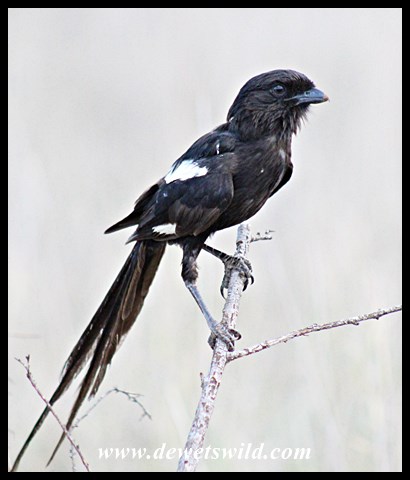
Urolestes melanoleucus
The unmistakable Magpie, or Long-tailed, Shrike inhabits open savanna habitats, typically where thorn trees dominate, and feed on invertebrates, lizards, small mammals, carrion and occasionally fruit. They generally avoid man-altered habitats and human habitation.
Adult Magpie Shrikes measure up to 50cm long and weigh around 85g.
Magpie Shrikes are gregarious and territorial, with groups numbering 3-12 occupying home ranges of up to 70 hectares in size (though much smaller while nesting). Their nesting season spans spring and summer. The dominant pair is monogamous and usually assisted by other group members in raising the chicks.
In South Africa, Magpie Shrikes are found mainly in Limpopo and Mpumalanga, extending marginally into Gauteng, Free State, Northwest, Northern Cape and Kwazulu-Natal. They also occur patchily through the rest of southern and eastern Africa. The IUCN indicates that the overall population of the Magpie Shrike is decreasing, possibly due to habitat loss, but still lists it as being of least concern at the moment.


 DeWetsWild
That’s s very fancy name for a shrike. He does look rather self important. 😃
And when you hear them chattering to each other you’d be even more convinced!
He’s a handsome guy with the tuxedo colouring and that long distinctive tail.
Pity he doesn’t have the voice to go with the look!
I see scrapydo2 asked my question already. Thanks for the answer!
Glad you could follow along in Afrikaans!
It is remarkable what can be done on the web! (But I must say I am *much* more impressed how fluent *you* are in both languages. 😊)
Afrikaans is our home language, and English the “commercial” language of South Africa – just two of eleven official languages in the country!
Thanks for making me aware of the newer name. I also prefer the older name as ‘magpie’ makes me think of the magpie in Europe, which (apart from the black-and-white) is completely different, as you say.
I realise it’s about a decade since all the name changes came into force, but I still find it hard to swallow some of them…
I am surprised it is that long already! Yes I also find some of the name changes difficult to accept and adapt to.
Striking and easy to recognise once shown; thank you!
And they like showing themselves off as well, so easily seen when visiting their haunts
Pragtige voëls en foto’s,soos gewoonlik,Dries!
Baie dankie, Dina!
They are iconic birds of the Kruger Park for me. I don’t recall seeing them anywhere else.
We’ve ticked them at a few other bushveld reserves, Anne – most in North West, Limpopo and Mpumalanga, and then in Hluhluwe-Imfolozi Park as well – but yes, if you really want to see them for sure then Kruger is the place to go, especially in the open savannas between Lower Sabie and Crocodile Bridge!
Wow! That was a long tail!😊Without that long tail it reminds of the magpie we have here in Sweden. It have about half the length of the tail that yours have.
Thanks, John! Actually your Eurasian Magpie, which is from the crow family, is much heavier in build than this species, which belongs in the shrike family. For me their alternative (older) name, Longtailed Shrike, is more appropriate.
I remember seeing these in Sabi Sands.
And probably many of them, Rosemarie?
The black and white are very striking on this bird. Handsome, like Hien said.
They do stand out in a crowd!
Is dit familie van die”Magpie” wat die mense so aanval in Australië en hier ook? Die Magpie is meer n kraai grootte voël met hierdie gevaarlike manier van dive bombing mense as hul naby hul nes gebied kom.
Nee, Ineke, hierdie is n soort laksman en lyk maar net baie soos die “magpies” in ander dele van die wereld, vandaar die naam.
Het so vermoed. Die laksman is nie die helfte so groot nie alhoewel sy kleure nogal aan Magpies herinner. Magpies lyk egter gladnie dieselfde nie. Gelukkig het ek nog nie met hul woeste aard in aanraking gekom nie. Hul kyk bv eerder vir Trompie uit as vir my.
Miskien omdat Trompie vir hulle duidelik soos n “roofdier” lyk dat hulle hom nie naby wil he nie?
Handsome bird with a very determined look!
Certainly very true, thanks Hien