
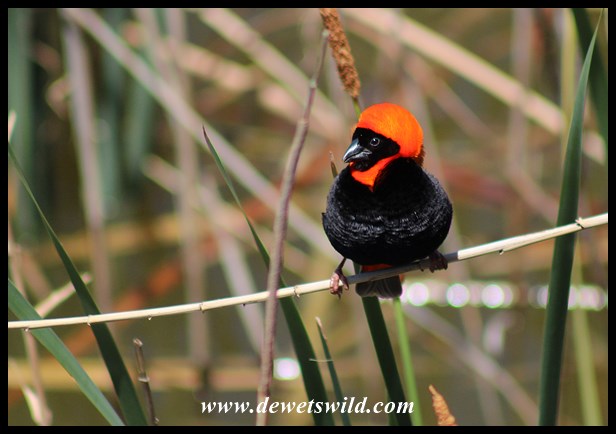
Euplectes orix
The Southern Red Bishop is a grassland bird, closely associated with water. They are also very common in agricultural areas where they can become pests to grain farmers, as their diet consists mainly of seeds and to a much lesser extent insects.
Red Bishops are a gregarious species, foraging in flocks and breeding in colonies, and often associate with other species of weaver and finch at roosting and feeding sites. They breed almost exclusively in reedbeds during the spring and summer. At the onset of the breeding season, males weave up to 13 grass-nests and display continuously to attract as many females as possible, mating with as many as 8 females in a season. Females are solely responsible for the incubation over a two week period of the clutch of 1-5 eggs and raising of the chicks, which leave the nest at about two weeks old. Southern Red Bishops weigh between 18 and 29g.
The Southern Red Bishop is widely, but discontinuously, distributed over much of East, Central and Southern Africa and, being regarded as common to abundant over this wide range is listed as least concern by the IUCN. It is found virtually all over South Africa, being absent only from portions of the arid Northern Cape Province.


 DeWetsWild
Why do the males get all the light? lol…it should be the other way around, but he is pretty 🙂
The avian version of the K-family… 😀
Die outjies is bekend
En is dit nie wonderlik nie, Tina, dat hierdie mooie voeltjies so volop is nie?
Ons is bevoorreg.
Ons het hulle verlede jaar hier in ons tuin gesien, maar nog nie hierdie jaar nie.
Dit sal hartseer wees as hul moes trek vanwee die droogte, Aletta?
Ja, beslis… Op die oomblik lyk die weer belowend. Hoop en bid dit sal reen
Ons hoop en bid saam met julle!
What a wonderful beautiful bird!😊 The bird that is yellow, it is a juvenile?
The drab-coloured ones are either females, John, or males in non-breeding plumage.
Another beautiful little bird I have only seen in Kruger Park, Hluhluwe/Umfolozi game reserves and grasslands in Mpumalanga. It is not a garden bird is it?
They often visit our garden in Pretoria as well as my mother’s in Germiston, Kim. Perhaps KZN has enough “natural” food for them not to have to visit gardens for supplementation?
Die mannetjie lyk maar vaal sonder sy broeipakkie. Mooi foto’s en inligting, Dries.
En is dit nie n jammerte nie, Dina?
Die wyfies is so vaal, so die mannetjies moet ook mos ‘n beurt kry om lelik te lyk! 😄
Very pretty bird! I can see how it got its name.
Pity they only look like this in the breeding season, our drab winters could do with the splash of colour!
Very colorful bird, at least for the males!
And then they only wear their best in the breeding time, Hien. In winter it is very difficult to tell the sexes apart.
Dis baie interessant! Dan is mannetjie en wyfie albei sommer net “little brown jobs” 🙂
Wat n jammerte, Tannie Frannie!
Glorious colors! What a cool bird you’ve featured, de Wets. Thanks!
Thanks, Jane!
Beautiful
Absolutely!
They really do look like they are wearing the vestments of the bishops.
Most striking!