
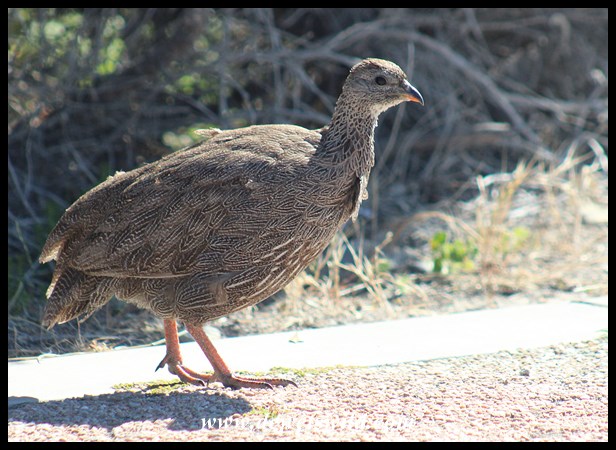
Pternistis capensis
Cape Spurfowl, also known as Cape Francolin, inhabits areas of fynbos, heathland and semi-arid scrub, usually near a reliable water source, and also utilises nearby orchards, vineyards, cultivated fields, pastures and suburban parks and gardens. It has an omnivorous diet, feeding primarily on seeds, fallen fruits and berries and a wide variety of invertebrates. Male Cape Spurfowl are quite a bit bigger than the females and may weigh up to a kilogram.
The breeding season for Cape Spurfowl commences in early spring but stretches right through to the end of summer. The nest is a simple scrape in the ground, hidden among vegetation, in which the female incubates a clutch of 1-4 eggs for around 3 weeks. Larger clutches of up to 14 eggs have been recorded, but are thought to be of multiple females laying in the same nest.
The Cape Spurfowl’s distribution is mainly centred on South Africa’s Western Cape Province, extending into adjacent areas of the Eastern and Northern Cape, and reaching southern Namibia along the course of the Orange River. With a common and stable population, the IUCN considers the Cape Spurfowl to be of least concern.


 DeWetsWild
We live in Edgemead and have a pair in our garden. The female is sitting on 9 eggs
Now that’s a family I wouldn’t mind having over for Christmas!
We got a female with 2 chicks nearly 3 weeks old in our garden. Saw something very disturbing today. Other bigger one, I think a male was after her chicks, pecking and chasing them! Why would this happen?
Interesting observation, Martie.
My guess would be that either the male thinks its time for the couple to start nesting again and so he’s chasing the previous brood away or he’s displaced her previous mate and now doesn’t want to waste energy raising another male’s offspring.
I love Francolins, they are like big chickens.
We do too, especially when they’re so “cocky”!
Beautiful bird, and it seems to be used to people. Does the female and the male have the same colors on the feather suit?
That’s quite right, John. The male and female’s plumage is exactly the same, but when they are together you can easily see that the rooster is much bigger than the hen. The male also has a sharp, thick spur at the back of the legs, just above the toes, but this isn’t always obvious (if you look carefully at some of the pics you might notice it)
Thanks again for sharing so I know of so many wild lives I never got to know before.
The pleasure is all ours!
They remind me somewhat of the grouse that we have here.
Indeed, the spurfowls and grouse are all from the phasianidae-family
Very pretty feathers.
Indeed a very fine pattern on each feather, Lois