
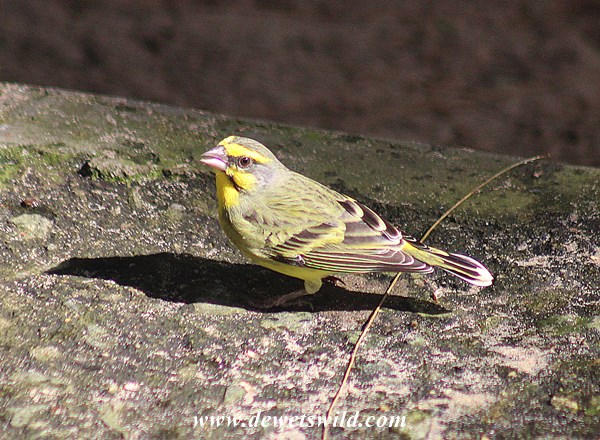
Crithagra mozambica
The Yellow-fronted Canary occurs in savanna and woodland habitats, and seems to be dependent on the availability of surface water for regular drinking. They penetrate more arid areas along well wooded water courses, and have extended their range into parks and plantations established in otherwise unsuitable grassland areas. They feed mostly on the ground, foraging for seeds, flowers, nectar and insects, and often form mixed flocks with other seed-eating birds. Adult Yellow-fronted Canaries weigh only between 9 and 16g.
Breeding season for the Yellow-fronted Canary spans spring and summer in South Africa. While they occur in small flocks outside the breeding season, pairs are monogamous and usually nest well apart from others. Nest building is mostly the responsibility of the females, who build a cup shaped nest of plant material and spiderweb in a tree or bush, quite high above the ground. The female is also solely responsible for incubating the clutch of 2-5 eggs for 2 weeks, while the male feeds her. The female also broods the chicks for the first few days after hatching, with the male then bringing food for both her and the chicks. The chicks leave the nest when they’re about 3 weeks old, but still remain dependent on their parents for quite some time thereafter.
In South Africa, this species is common in the Eastern Cape, Kwazulu-Natal, Mpumalanga, Limpopo, Gauteng and parts of the Free State and North West provinces. Furthermore, the Yellow-fronted Canary also has a wide distribution over west, central, east and southern Africa. While listed as “Least Concern”, the IUCN notes that the international pet trade is probably causing a decline in the population of the Yellow-fronted Canary.


 DeWetsWild
As if the little yellow canary wasn’t cute enough, you tossed in a blue waxbill to crank it up a notch 😉
The first photo makes me want to break out into the Sesame St song ‘one of these things is not like the other’ 🙂
Yep, that little Blue Waxbill’s mom is very worried about him mixing with the wrong crowd 😉
Pragtige voëltjie en weereens besondere interessante inligting, Dries!
Hulle laat my altyd glimlag, Dina, met die dat hulle omtrent nooit stil sit nie en my so maklik tussen die doringbosse ingelok kry agter n foto aan!
Hi guys. I don’t think these guys live in or around Durban but I have seen them up the North coast. The male is a; hard working husband and dad!
Hi Kim! We haven’t seen them often in urban settings either, but the SABAP distribution map does show that they’ve been recorded from several of our big cities (probably in parks and areas of natural vegetation rather than around houses): Port Elizabeth, East London, Durban, Pietermaritzburg, Johannesburg, Pretoria, Nelspruit all included!
I wonder if Mina Birds lay blue eggs. After a bad wind, a friend of ours found a blue egg on the ground, and I have tried to find out. So far nobody can tell me. They are the birds in India that seem to be able to speak if trained. I don’t want to train them, because I love their natural calls early every morning.
Hi Beth! I found this picture on wikipedia of Myna eggs, they describe it as “turquoise blue” (being colourblind, I wouldn’t know if they are right): https://en.wikipedia.org/wiki/Common_myna#/media/File:Acridotheres_tristis_MHNT_227_La_Reunion.jpg
The egg Wikipedia shows seems to be the same hue, just not the same gradation. The egg I found was much more intensely blue.
Perhaps you’ll find a copy of this book at your local library, Beth, and it might just show you what you’ve found!
I see others have uploaded pictures, but I am not able to do it. I wonder why, or maybe I should say I wonder how to do it. I wanted to show the blue egg in relation to the size of an adult hand.
The photo John has shown us here, Beth, is on his blog – posting the link to it here in the comments is showing us the photo. Perhaps you could try the same?
I do hope you are writing a book or maybe books about all this. Your documentation is fantastic and so are the illustrations.
That is very kind of you, Beth. We’ve been toying with the idea of a series of books on some of our favourite wild destinations, but haven’t had the courage to take the jump yet.
Very similar to the finches that show up here! 🙂
Perfectly built on the seedeater-template!
Subtle beauty, especially that bit of yellow.
janet
They can hide surprisingly well despite that bright yellow splash!
Such a pretty little bird, but I could see the pet trade causing a decline. Shame. I do like the photo of one canary….yelling at the other two. Such a great snap.
Isn’t it sad that humans always wants to possess anything that is beautiful…
It really is sad. Whatever happened to sharing?
They are very similar our greenfinch, both to the look and they seems to be aggressive to each other as weel.

They can be rather quarrelsome!
And a lovely photo as well, thanks John!