
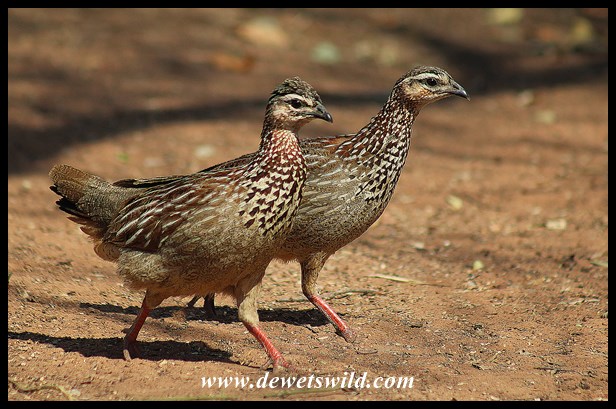
Dendroperdix sephaena
Crested Francolins inhabit dense woodlands, often in riverine areas and with a sparse grass cover, and areas of thicket in more open savannas. They follow an omnivorous diet, including insects, seeds, leaves, shoots and fruits and berries according to whatever is most easily available in the season. Adults weigh from 240 to 460g and are about 33cm long.
During the breeding season, which stretches through spring and summer, Crested Francolins are usually seen in monogamous pairs or small family parties, forming mixed groups of up to 7 birds at other times. Their nests are shallow scrapes in the ground lined with soft plant material, well hidden among grass and shrubs. Clutches consisting of 3-7 eggs are incubated by the female for around 3 weeks. The chicks are precocious and leave the nest about two hours after hatching to start foraging with their parents.
The Crested Francolin is distributed over much of eastern and southern Africa, and considered of least concern by the IUCN. In South Africa it occurs commonly in the provinces of Kwazulu-Natal, Mpumalanga, Limpopo, Gauteng and North West.
Brett Hilton-Barber and Lou Arthur in their guide to birding in Kruger Park mentions an apparent symbiotic relationship between African Wild Dogs and Crested Francolins, in which the francolins are allowed to peck up scraps of leftover meat around wild dog dens without harrassment, and in turn provide advance warning to the pack of dogs whenever dangerous predators are close to their den.
The distinctive call of the Crested Francolin is often heard at sunrise in many of our favourite wild places.


 DeWetsWild