
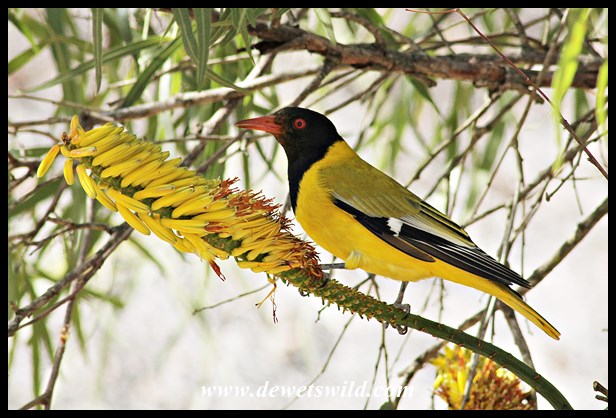
Oriolus larvatus
The Black-headed Oriole inhabits acacia savannas, broad-leaved woodlands and montane and coastal forests, where it feeds on fruit, seeds, nectar and insects. It also recently adapted to plantations, suburban parks and gardens. Adults weigh between 60 and 80g and are about 20cm long from beak to tail-tip. They are usually seen singly or in pairs.
Black-headed Orioles breed mostly in spring and summer in South Africa. Nests are cup-shaped and built of grass, lichens and moss, usually high up in the slim forks of trees. Clutches of 2 or 3 eggs are incubated for two weeks, and the chicks fledge about two weeks after hatching.
The Black-headed Oriole occurs from Ethiopia to Angola and South Africa. In South Africa, the species is resident year-round and occurs from the Garden Route in the Western and Eastern Cape, through Kwazulu-Natal to Mpumalanga, Limpopo, Gauteng and parts of the North West Province. The IUCN considers the species of least concern, siting an increasing population and expanding distribution range.


 DeWetsWild
What a handsome guy! Love the bright yellow.
Certainly makes him stand out everywhere he goes!
Very pretty Oriole!
And even more so in real life, Hien!
A very beautiful bird, colorful and I love that yellow color it have. Great pictures as usual! 🙂
Thanks John! Indeed, the Black-headed Oriole has very striking plumage.
So ‘n pragtige kleur voel!
Baie treffend – tot vir my met my kleurblinde oe kry die wielewaal nie weggekruip nie!
Die foto’s in die koraalboom is werklik besonders.
Baie dankie, Tannie Frannie!
Hi guys, spectacular photos again. The black-headed and golden orioles used to be common visitors to our garden when I was a child but are another bird that have become a very rare sight in Durban gardens. Probably because of greater urbanisation and the resultant pollution or just habitat destruction and scarcity of food. It is such a shame. Kim
I wonder if the preponderance of exotic bird species in Durban might have something to do with so many species disappearing from your area, Kim? Here in Pretoria we are seeing new species adapting to the urban environment every year, which is the total opposite of what you are experiencing.
Hello. Probably, but the bird species that seem to have increased in population are the members of the starling family – the mynahs, glossy and red-winged starling – and even the little white-eyes, sparrows and mannekins have become fewer in number. A lot of people in the northern suburbs of Durban say they have parakeets and parrot-like birds in their gardens now, which we never say years ago. A result of the breeding of caged birds that have escaped their confinement. On the actual beach itself their are far fewer of the gulls and other salt-water birds that used to be common. Pigeons and mynahs are more numerous on the beach as well!
That’s exactly what I though, Kim – Those feral parrots, parakeets, pigeons, mynahs and mallards (to name a few) are forcing indigenous species to vacate the city.
Wow! What a bold, beautiful bird!
Certainly one of our most strikingly coloured species, Kathy!
Nice ones Dries – and also in the colours of my favourite soccer team 👍
The oriole can become their mascot!
What a wonderful bird. Great photos!
Thank you, Cayenne!
You’ve captured another beautiful bird!
Thanks Deb!
Good looking bird. 🙂
Agreed!
What a beauty! I can’t decide whether I prefer the shot with the yellow flower or with the red. Ahh, well, they’re both/all lovely!!
janet
Thanks Janet! Luckily the oriole’s love for pretty flowers (and nectar) makes for pretty photographs.
What a beautiful bird.
Indeed, Maralee – these pictures hardly does its striking plumage justice.