
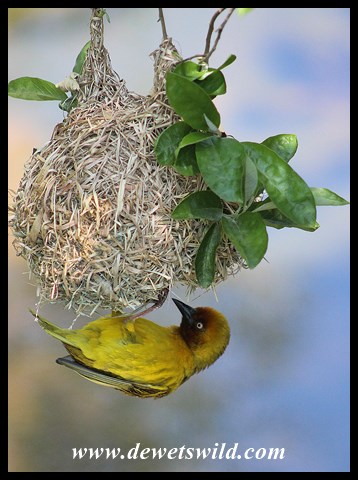
Ploceus capensis
The Cape Weaver is common in fynbos, wet highlands, coastal thickets and grasslands with easy access to water and stands of trees. It shows a marked preference for agricultural areas causing some conflict with grain and fruit farmers. It feeds on a wide range of plant material (especially seeds, fruit and nectar) and insects, often in mixed flocks with other weavers, sparrows and canaries. They weigh between 28 and 54 grams.
Cape Weavers are gregarious, nesting colonially in reeds, trees or fences (not necessarily near water) during the spring and summer months, often together with other species of weaver and bishop. Males mate with as many as 7 females in a season and has to weave several nests of grass and reeds to accommodate them – females will often tear apart nests that they find inferior. If accepted, the female will line the nest with soft vegetation and feathers and then, after mating, lies a clutch of 2-5 eggs, which she incubates for two weeks. The chicks fledge at about 17 days of age.
The Cape Weaver is a common to abundant species in South Africa, with a limited distribution outside our borders in Swaziland, Lesotho and the extreme south of Namibia along the lower Orange River, and considered of least concern by the IUCN. They are common along the Atlantic coast and adjacent interior of the Northern Cape, throughout most of the Western and Eastern Cape and Kwazulu-Natal, the eastern Free State, Gauteng and the Highveld of Mpumalanga and Limpopo Province.


 DeWetsWild
Sulke stoute knaapies!! Miskien weet hulle iets wat ons nie weet nie! 😉
Hulle sien kans vir baie!
Baie!! Slim ook… maak babtjies en gee pad!! 😉
Will mate with 7 different females who might tear apart their nest if not satisfied? bwahahaha – this little guy is a masochist 😀
The lengths some guys will go to to get some…
Beautiful birds and you captured them well! I especially like th last shot with his wings spread!
Thanks a lot, Montucky!
Is dit dirselfde weaver wat ook in noorde van die land is? Hul lyk my anders. Ek’s gewoond aan die mannertjies met hul swart maskers. Mag dalk my misreken. Daar is darem maar n groot verskydenheid van voël-lewe in SA. Dis n fotograaf se paradys as mens in voëls belangstel. Baie interessant.
Dis nou nie altemit nie, Ineke – ons land se voellewe gee ons groot vreugde en ons is baie trots as n nuwe spesie sy opwagting in die tuin maak! Die Kaapse Wewer is een van vele spesies vinke en wewer wat in ons land tuis is. Twee ander spesies hier het die swart maskertjies waarvan jy praat – die swartkeelgeelvink is een van hulle: https://dewetswild.com/2017/06/13/southern-masked-weaver/
Aaa ek sien. Het nog glad geen wewers hier gesien nie. Glo nie hier is nie.
Net weer n bewys van hoe uniek New Zealand se fauna en flora is!
Dit kan jy weer sê! Hierdie tyd van die jaar sodra die bome begin blom is dit n “kakafonie” van voëls veral vreg oggend. Dit gesels en lawaai en jaag mekaar. Die Tui’s is baie besitlik. Hul kies n boom en net hy en vroutjie kan deel. Die res moet nie eers waag om naby te kom nie. Terwyl een jaag spring n ander gou in en neem n paar lekker slukke nektar.Ek geniet dit elke oggend om hul so te sien.
Dit moes vir jou fassinerend gewees het om met soveel nuwe voelsoorte kennis te maak, Ineke?
Beslis. Hul hou hier voël tel dae. Die Kereru is juis weer volgende week aan die beurt. Mens stuur net hoevell jy gesien het op daardie dag en waar. Mens kry dan terugvoer van hoeveel daar gesien is en waar. Daar is ook n tuinvoël kyk dag. Sit vir n uur en kyk hoeveel en hoeveel verskillendes mens in die uur sien.
Dit klink na ons soort tydverdryf!
Dis eintlik baie lekker. Hul is baie natuur bewus en het goeie ondersteuning. Forest and bird is n bewaringsorganisasie en hul doen baie.
Hier het hulle al hulle geel jassies aan maar het nog nie begin bou nie
Hier by ons sing hulle ook al hul hartjies uit om die wyfies te beindruk.
Ons huo duime vas dat hulle maar susesvol is want een het 5 keer gebou verlede jaar – alle tevergeefs
As gevolg van die fiemiesrige wyfies, Tina, of oor ander redes?
Daar is seker te veel tweederangse mannetjies wat geen aanklank by die wyfies kry nie
Looks like a curious little bird!
They’re very cheeky, Kathy, and will approach very close to humans if they think there’s food available!
Another beautiful gallery of image.
Thanks very much, P J B!
Cool nest- and my two fav photos are the opening and closing shots – nice way to Sandwich the post – the male all stately and then those wings !!
Entirely unintentional, but I’ll gladly accept the compliment. Thank you! 😉
🙂
Those nests are a marvel, and so is the Cape Weaver. Excellent information with beautiful photos. Thank you.
Thanks very much, Hien!
Amazing nests these birds make. You can easily see why they got the name Weaver.
Amazing is certainly the best way to describe their nest building talents, Cayenne!
Not too much pressure on the males to get the nest right!
I’m so happy I’m not a weaver – I might just have given up hope long ago!
Such a beautiful little bird. 🙂 It´s a bird who like to have a harem, it looks likes, 7 females. 😀 It’s very early as the chicks can fly, only 17 days, they must evolve quickly.
Isn’t it amazing how quickly birds develop and grow!? Even if counting the time that it takes to incubate the eggs, they go from nothing to being able to fly in just over a month!
I love that yellow. Imagine a parrot saying, “Pretty bird, pretty bird.” 🙂
janet
They can also cause just as much of a racket as a parrot can, especially at their nesting site!
😱😱😱