
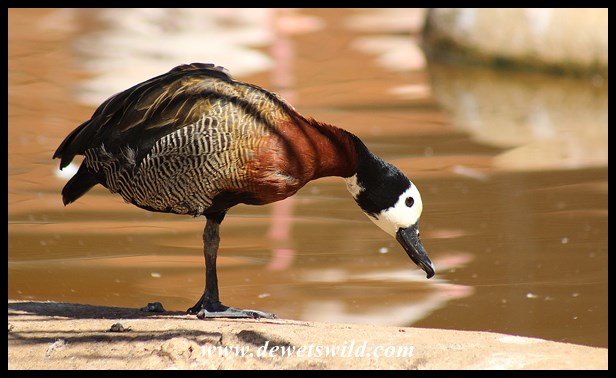
Dendrocygna viduata
Commonly found in vegetated freshwater habitats in open areas – lakes, swamps, large rivers, dams, estuaries, rice fields (can be a pest when they feed on young rice plants) and even sewage treatment installations, with mudbanks and sandbars for roosting, White-faced Whistling Ducks feed on grasses, seeds, buds, aquatic plants and algae, and aquatic invertebrates like worms, molluscs, insects and crustaceans. The sexes are quite alike, both weighing around 740g.
White-faced Whistling Ducks are most active at night, feeding from dusk to dawn, although they do become more diurnally active in winter. Outside of the breeding season White-faced Whistling Ducks often congregate in enormous flocks numbering several thousands – as many as 70,000 have been counted on river deltas in West Africa!
Breeding commences at the start of the wet season and lasts throughout, when they build their nests on dry ground in dense vegetation, mostly but not always near the water, and occasionally in loose groups or colonies. Pair bonds are very strong and they mate for life. Unusually for ducks, White-faced Whistling Duck males actively take part in the incubation of the eggs and care of the ducklings. The nest is a hollow lined with plant material, hidden in and under dense vegetation. The clutch consists of between 4 and 16 eggs, but normally about 7 to 11, and is incubated for about 4 weeks. Parents will feign a wing injury when predators approach, in order to distract its attention away from the ducklings. The ducklings grow quickly and start flying at about two months old, though they often stay with their parents until the next breeding cycle starts. Following the breeding season, adults undergo a three week period of flightlessness while they moult, keeping to densely vegetated wetlands during this time.
The IUCN estimates the global population of the White-faced Whistling Duck at as many as 2.8-million, and growing, and lists the species as being of least concern. It occurs widely and commonly in Madagascar, Sub-Saharan Africa, parts of South America and the Caribbean. In South Africa, this species is found along the coast in the Western and Eastern Cape, and throughout Kwazulu-Natal, the Free State, North West, Gauteng, Mpumalanga and Limpopo.


 DeWetsWild
We were fishing at Roodeplaat Dam.. Gauteng.. South Africa… saw 1 White-faced Whistling duck together with 2 “Kolganse” (Egyptian Goose) and their 7 little chicks. The Duck stayed with them the whole time… as if they adopted it… beautiful.
What a unique piece of behaviour to witness, Annlin! Thank you for sharing this interesting snippet with us.
I could not find the blue waxwing but found these guys. These ducks sound like a dogs squeekie toy:
Now imagine thousands of them whistling together!
THAT would be deafening!
OK….now I’ve got to hear what these guys sound like. Our ducks ‘quack’.
They’re very distinctive aren’t they – with that rusty red breast, white face, and black cap. I never appreciated that ducks (or maybe just some ducks) can’t fly when they are moulting. Now the expression ‘sitting duck’ makes sense.
I think it is one of those expressions that’s used so often that the utter helplessness and defenselessness it implies is lost on us!
Beautiful duck! But it look so big, almost like a little goose, but a mallard weighs more. Flocks with 70,000 ducks, wow! I don´t think we have so big lakes here in Sweden so they can sit. 😀 I’ve seen geese in flocks with about 1000-2000, and only that’s huge, but 70,000, what a sight i must be! 🙂
That must be a miraculous sight, John, and imagine the noise 70,000 ducks whistling together would make!
Pretty cute! 🙂
janet
Like little nuns (where they get their Afrikaans name “Nonnetjie-eend” from)!
I think that most animals who are thought of as cute are made so because of their eyes. I agree very much.
You may well be right, Cayenne! I think the eyes on any living being is where we “connect” with each other.
Dogs have a way of doing that