
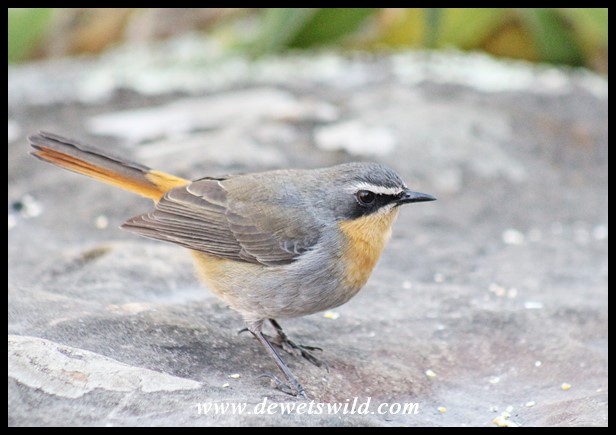
Cossypha caffra
Most South Africans would be very familiar with the confiding little (28g) Cape Robin-chat – it was after all voted South Africa’s favourite bird!
Cape Robin-chats have adapted very well to human habitation, being extremely common in suburbs and around farmsteads. They occupy a wide range of natural habitats; from arid Karoo thicket vegetation along water courses to the edges of forests and suitably dense montane vegetation, from whence some birds move to lower altitudes during harsh winters. Cape Robin-chats search for food on the ground, amongst dense vegetation or out in the open, feeding on invertebrates, tiny frogs and reptiles, fruits and seeds. They are very fond of their daily splash bath, and are excellent at mimicking the songs of dozens of other birdspecies. They are usually seen singly or in pairs.
Pairs are monogamous and most hold their territories for years on end. The cup-shaped nest is usually built low in a dense bush. Breeding reaches a peak in spring. Clutches contain 2 or 3 eggs and are incubated by the female for between 14 and 19 days. Both parents feed the chicks until they fledge at about two weeks old and then for another few weeks more. The maximum recorded life span of a Cape Robin-chat is over 17 years!
The Cape Robin-Chat is a common resident in every South African province, though they are very patchily distributed north of our borders into East Africa, and with an apparently large and stable population is considered of least concern by the IUCN.


 DeWetsWild
What a lovely bird, Dries. I voted for both. Good luck. Your blog deserves to win. 🙂
Thank you very much, Sylvia, we really appreciate the support!
Daardie verkeerdeveer-foto is sooo bekoorlik!
Die janfrederikkies is sulke nimlike voeltjies!
I laughed at the little wet one. Someone was having a “bad feather” day 😉
I know some people who look very much the same around shower time in the morning!
Beautiful, colorful bird captures!
Thank you, Amy!
Very beautiful pictures of the beautiful bird. 🙂 Pic number 6 is so cute. 🙂
Thanks, John!
I love how fluffed up they look when they are wet!
And that was on a particularly cold day as well, Lois, which must mean that they also think cleanliness is next to godliness…
I didn’t know about the chat part.
That was added with all the name revisions a few years ago, Colonialist. The same revisions that turned a Dikkop into a Thick-knee…
Why do the ‘experts’ have to mess about with names of plants, birds and animals, often with very slim justification? Or on technicalities that are not really important.