
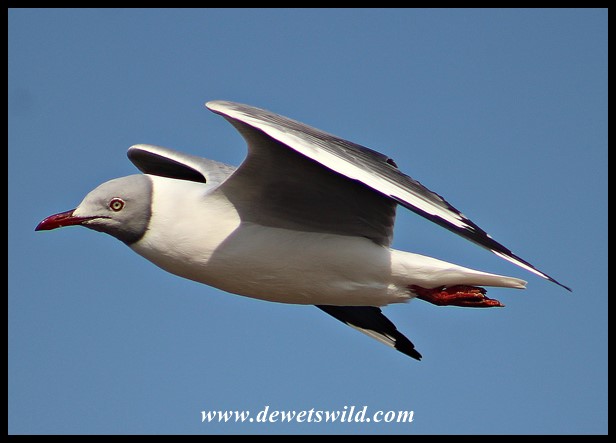
Chroicocephalus cirrocephalus poiocephalus
The locally common Grey-headed Gull is the only species of their kind regularly encountered at open, shallow inland freshwater habitats in South Africa, though they are also found along the open coast and at lagoons and estuaries, and often in close association with human activities, scavenging on our waste. They do not wander far out to sea like many other gulls do. Their natural diet includes fish, molluscs, eggs and carrion. This is a medium-sized gull, weighing in at about 300g.
Grey-headed Gulls are gregarious and rarely seen alone. They also breed in tightly packed colonies, with nests positioned on the bare ground on islands or among clumps of vegetation. Though breeding activity has been recorded through most of the year, it reaches a peak in early winter. Clutches usually consist of 2 or 3 eggs.
It is estimated that there are more than 2000 breeding pairs of Grey-headed Gull in South Africa. Though they can be seen almost over the entire country, their biggest concentrations are to be found around Cape Town, Port Elizabeth, on the North Coast of Kwazulu-Natal and on the Highveld of the Free State, North West, Gauteng and Mpumalanga Provinces. Apart from our neighbouring countries, the Grey-headed Gull also has a patchy distribution throughout East and West Africa, Madagascar and parts of South America. The IUCN listst it as “Least Concern“.


 DeWetsWild
Is julle by die see die vakansie?
Ons gaan vir so paar dae langs die see wees ja, en nog n paar in die bos daarna, maar ons moet nog so 2 weke daarvoor wag, Tina. En jy?
As mns aftree is dit mos heeljaar vakansie!
Hello. 2000 breeding pairs doesn’t seem a lot to me. I’m sure before man intervened in their lives there were probably more than 2 000 000!
You may well be right, Kim, though these days the grey-headed gull really makes the most of all our waste!
Not much different from ours! 🙂
Do they also occur in your part of the world, Teresa? What are they called there?
Just plain Seagulls! I’ll send you a photo, do you have an email??
😀
That’d be lovely, Teresa – dewetswild@yahoo.co.za
Very handsome bird!
Pity their manners aren’t equally as appealing!
Great set of bird captures, de Wets. Interesting post.
Thanks very much, Jane!