
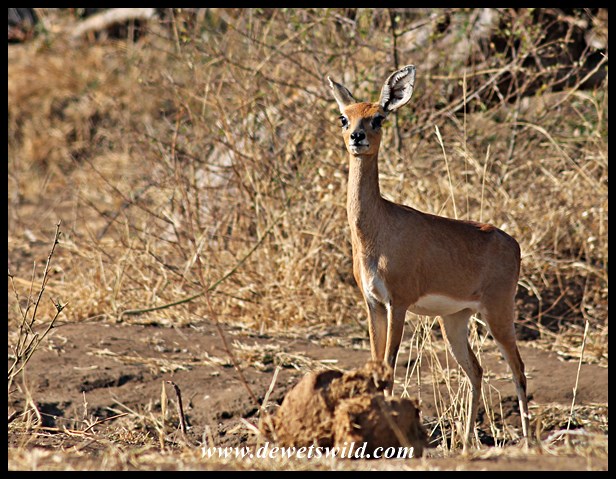
Raphicerus campestris


The little Steenbok is one of South Africa’s best known and most widely distributed small antelope. They weigh 11kg on average, and have a shoulder height of between 43 and 52cm. Only the males carry the straight little horns of between 9 and 19cm in length.


Steenbok have an extremely wide habitat tolerance, occurring from deserts to grasslands and bushveld and even in farmlands and on the edge of suburbia. They reach their highest population densities in open areas with short to medium length grass and only a scattering of trees and shrubs. They’re not dependent on water, but will drink when it is available. They feed on grass and leaves in about equal measures and will also ingest seeds, pods, fruit, roots and bulbs.


At high population densities individual steenbok of both sexes mark and defend small territories, while at lower densities pairs that share a common home range is more usual. Within their territories the Steenbok has preferred areas for feeding and resting. Steenbok are mostly diurnal animals, most active around dawn and dusk and resting up in deep shade during the heat of the day, though they do tend to be more nocturnal in their habits in areas where they are frequently disturbed. When threatened, Steenbok will prefer to try and hide, even in holes in the ground, and will wait until the last possible moment before jumping up and darting away at breakneck speed. Most interestingly, Steenbok defecate and urinate in scrapes they hoove in the ground and then cover again with soil, just like a cat.


Single lambs are born at any time of the year, though mostly in the rainy season, and are hidden in long grass, thickets or holes in the ground for the first few weeks of their life. Only about half of the lambs reach the weaning age of 3 months. They are fully grown by 14 months of age. All Africa’s larger predators, from the size of eagles, pythons and jackals to lions, prey on the Steenbok, and their natural life expectancy is only 6 to 10 years.


With an estimated population in excess of 600,000, and stable both inside and outside protected areas, the IUCN considers this common little antelope’s conservation status “least concern”. They can be found in all South Africa’s provinces, and are especially easy to observe in the Kruger National Park, Pilanesberg National Park, and Willem Pretorius Game Reserve.
 DeWetsWild
Pingback: Pilanesberg National Park: 10 – 13 May 2012 | de Wets Wild
Pingback: Mokala National Park | de Wets Wild
Pingback: A month of monochrome memories: All Ears | de Wets Wild
They’re so darn cute!
Absolutely, thanks Michael!
Ja… hulle sal ook op ons wens lys wees!! Ons sal ‘n baie groot plaas moet aanskaf!! 😉
Hulle is so klein en fyn, mens kan hulle sommer in jou sitkamer aanhou. Nie dat ek iets so wreed sal probeer nie, hulle hoort vry in die veld.
Ja!! So vry soos al die ander oulike diere wat ons wil aanhou!! 😉
Maar nie in my sitkamer nie 😉
Nee… kan jy jou indink… al daai bokdroletjies op die mat!!
Dis hoekom ons haas ook buite moet bly 😀
Nou wat nou!? Ek on my nooit indink day julle haas mense sou wees nie!! 😉
Ja wat, ons almal het maar n donker geheim in die kas…
Wha ha ha! Vlakhaas of spinghaas geraamte? Ek wonder…
Troetelhaas. Konyn eintlik, as mens wil tegnies raak.
Dit maak dit erger… of hoe nou? Troetelhaas? Ek dink Joubert het liewer ‘n mak meerkat noodig!! 😉
Ek dink n mak meerkat sal minder vernietigend in die tuin wees. So klein hasie het n eetlus wat skrik vir niks!
Vat die haas wildtuin toe… ek’s seker ‘n honger jakals sal bly wees!! (Ek dink ek moet nou loop… voor jy my lewens lank verban!) 😮
Ek sal jok as ek se dat ek dit nie al oorweeg het om die haas te gebruik om n roofdier te lok nie. Maar ou Snoesie is so intelligent, sy sal weet mens voer iets in die mou.
Lekker naweek AJ!
Klink my ou Snoesie regeer! 😉
Such pretty animals, I’ll have to show your photos to my daughter! Thanks for the post!
They’re very lovable, Zsuzsa, and thanks for the kind comment!
Pragtige reeks. Die een wat lê is ‘n puik foto. Dankie ook die info.
Altyd so gaaf, baie dankie Spokie!
Strangely enough, particularly considering the interesting facts you give about them, not a species I remember as having seen too often.
We’ve seen them at Chelmsford, Imfolozi and uMkhuze, but generally Natal doesn’t have much of the dry, open grasslands they prefer.
I must look out for them when next in any of those reserves.
Great Pictures.
Thank you Sonya!
Such beautiful and gentle looking creatures. Very interesting facts about them. 😎
Thank you Sylvia!
Pragtig… een van my gunstleinge
Baie spesiale ou bokkies die.
Oh!!! Very interesting…I did notimagine they were able to hide in holes….
May be they cover their urine and faeces to avoid being followed by other predators?
Just thinking… Thanks a lot for sharing your posts!!!! Have a great weekend!
Thanks Ilargia, and you are 100% on target with your thinking!
These enormous ears and eyes are sooooo cute and beautiful! What a gorgeous animal.
Wonderful photo’s again… as always!
Thank you so much Noortje! We agree, the little Steenbok is very cute.
Mooiste ou klein bokkie. Amper mooier as die Duikertjie of Klipspringer. Ek dink die gesiggies vertoon sagter.
Hulle is beslis besonders, dankie Ineke!
pragtige foto’s!
Dankie Aletta!
That’s really a pretty little antelope!
Finding a little Steenbok is always a nice treat 🙂
hello beautiful.
The Steenbok will be most flattered, Gavin 😉
🙂
Such gentle looking creatures…
They are Lois! Those soft eyes make Bambi seem like a bully 😀
Thank you for another lovely and informative presentation!
It’s our great pleasure to share it all with our friends, Lindy!
They do have pretty ears.
Little radar dishes 🙂
Is it just me? Several animals look alike and I have a hard time to remember which one is which ;-( This one has pretty ears though (which I don’t remember see on others. And pretty nose too 😉
Thanks for sharing! Have a wonderful day!
No Helen, you are quite correct, and many people at first find our antelope population confusing. The Steenbok, and the Grysbok we introduced last week, are closely related for instance, and often people see a grysbok and confuse it for the much better known steenbok.
Beautiful animal. I think is amazing to live among them, right?
Thanks Monica. We’re definitely blessed to be living in a country so rich in wildlife, but sadly even here they are mostly confined to nature reserves and national parks and, to a lesser extent, farmland.